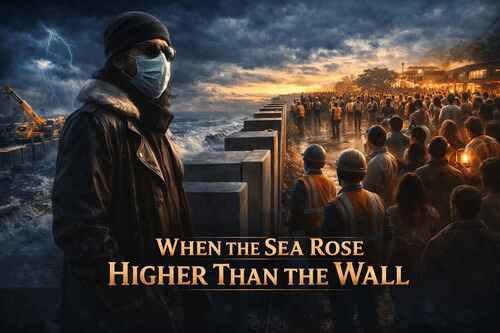
In North Jakarta, the ground no longer felt solid beneath one’s feet.
It was not an earthquake that troubled the people, nor a sudden calamity announced by sirens and flashing lights. It was slower, quieter, and far more unsettling. Each year, the land sank a little further, as if the city itself were bowing to the sea in weary surrender. Streets dipped at odd angles. Doors refused to close properly. Wells tasted faintly of salt. Children learned, without being told, which corners of their homes would flood first.
The sea, patient and relentless, had begun to loom higher than the flood barrier.
The embankment — once a proud symbol of protection — stood cracked and tired. Hairline fractures crept along its concrete body like veins beneath ageing skin. Engineers had warned of it for years. Reports had been written, meetings held, promises made. Yet the repairs were always delayed, postponed until “later,” until “the right budget,” until “the next administration.”
Water, however, did not wait.
At dawn, when fishermen returned with their modest catch and shopkeepers raised metal shutters with weary arms, the sea pressed itself against the wall, listening. And in certain places, it whispered through the cracks.
Among the residents was a man few truly knew.
They called him DewaBuku.
No one was quite sure where he came from. He had arrived months earlier, quietly renting a small room near the harbour. He was tall and broad-shouldered, with long black hair falling to his shoulders. He wore a black beanie pulled low, dark sunglasses even under clouded skies, and a pale green medical mask that concealed most of his face. A long black leather coat hung from his frame, its white fur collar catching the light, and loose dark-blue baggy jeans swayed as he walked. White Nike trainers, always clean, struck the ground with unhurried certainty.
Some thought he looked suspicious. Others thought him simply eccentric.
But DewaBuku watched.
He listened to the arguments in coffee stalls, the quiet despair of mothers sweeping water from their kitchens, the fishermen muttering about tides that no longer obeyed the moon. He noticed how people spoke of the embankment as one might speak of an old relative — fondly, but without expectation.
The inciting incident came on a night when the sea pushed harder than usual.
Rain fell in relentless sheets. The tide rose higher than any could remember. Water seeped through the widening cracks, spilling into streets like an uninvited guest who knew the way too well. Panic rippled through the neighbourhood. Buckets were filled, pumps were dragged out, prayers were whispered.
The embankment held — barely.
The next morning, the cracks were no longer subtle.
That was when the community gathered.
The meeting took place beneath a tarpaulin stretched between two lamp posts. Men and women stood shoulder to shoulder, the smell of damp earth and seaweed lingering in the air. Voices overlapped — anger, fear, exhaustion.
“We’ve reported this for years,” one man shouted.
“They will come only after we drown,” another replied.
“What good is talking anymore?”
Local officials stood awkwardly at the edge, offering cautious reassurances without conviction. The embankment, they said, would be addressed. Soon. In time.
DewaBuku had remained silent until then.
When he stepped forward, some people frowned. Others turned away. A few watched closely.
He removed his sunglasses but kept the mask on.
“There is a solution,” he said calmly.
The crowd quieted — not because his voice was loud, but because it carried certainty.
“The embankment must be raised,” he continued. “Not patched. Not delayed. Raised properly.”
Murmurs followed.
“With what money?” someone scoffed.
“And by whom?” another demanded.
DewaBuku paused. Then he spoke the words that shifted the entire conversation.
“Dutch dam engineers.”
Laughter erupted at first — short, incredulous bursts.
“We can’t afford them!”
“This isn’t Europe!”
“Be serious!”
But DewaBuku did not flinch.
“They are experts in holding back the sea,” he said. “Their land exists because they refused to surrender. There are modular flood barriers — precast concrete systems. They can be installed in forty-eight hours.”
Silence returned, heavier now.
“We can crowd-fund,” he added. “Together. Not waiting for permission that never comes.”
The confrontation was not with the sea alone — it was with doubt.
Arguments followed late into the evening. Some accused him of false hope. Others whispered that he was mad. But there were also those who saw something else: resolve.
A woman whose home had flooded three times stood up.
“If we do nothing, we lose everything,” she said quietly.
A fisherman followed.
“I’d rather risk my savings than my children’s lives.”
Slowly, painfully, consensus formed.
They pooled their money. Not equally, but willingly. Jewellery was sold. Savings cracked open. Contributions came with trembling hands and steady hearts.
Emails were sent. Calls were made.
And astonishingly, the answer came back swiftly.
The engineers would come.
The midpoint arrived with their arrival.
Tall, efficient, unmistakably foreign, the Dutch engineers examined the embankment without ceremony. They spoke in clipped tones, measuring, calculating, nodding grimly.
“It should have been done years ago,” one of them said plainly.
Work began immediately.
Forty-eight hours.
Massive precast concrete blocks were brought in, slotting together like pieces of an immense puzzle. Cranes moved through the night. Floodlights illuminated determined faces. Children watched from windows as if witnessing a miracle.
But not everyone welcomed the change.
A local contractor, long accustomed to slow projects and quiet profits, confronted DewaBuku.
“You’re making us look bad,” he hissed. “This isn’t how things are done.”
DewaBuku met his gaze calmly.
“This is how lives are saved.”
Tension hung thick in the air. Rumours spread of permits, of legal trouble, of interference. Yet the work continued, driven not by authority, but by collective will.
The second plot point came on the final night.
A violent tide surged earlier than predicted.
Water slammed against the embankment as the final section was being set.
For a moment, it seemed the sea would win.
The climax arrived at dawn.
As the final concrete segment locked into place, the tide reached its peak. Waves crashed, foam flying high into the air. People stood watching, breath held, hearts pounding.
Then — nothing.
The water stopped.
It pressed, it tested, it raged — but the wall stood firm.
Three metres higher.
Solid.
Unyielding.
Cheers erupted. Some cried openly. Others simply sank to the ground in relief.
The falling action unfolded gently.
The engineers departed as quietly as they had arrived. The embankment remained — a promise made of concrete.
For the next two years, at least, North Jakarta would breathe easier.
That evening, the community gathered beside the strengthened wall. Food was shared. Laughter returned, tentative at first, then free. Children ran along the embankment, their footsteps echoing with a new confidence.
Someone raised a toast — to unity, to courage, to a man who had spoken when others hesitated.
DewaBuku stood slightly apart, watching the sea.
It still waited.
But now, so did the people.
And for the first time in a long while, they were not afraid.
*****THE END*****
Author Profile

Categories
Related Posts

Grandma Doris had never trusted the Internet.She didn’t like how it “talked back” to her...
Read More
DewaBukuJSW
Serial Title: The Clockmaker's Secret Bayu didn’t remember falling asleep. One moment he was staring...
Read More
DewaBukuJSW

Serial Title: The Clockmaker's Secret The ticking had stopped. Not faded. Not slowed. Stopped. Bayu...
Read More
DewaBukuJSW

Serial Title: The Clockmaker's Secret Bayu woke up earlier than usual. Not because he wanted...
Read More
DewaBukuJSW

The village of Larabanga, in northern Ghana, woke each morning to the sound of goats,...
Read More